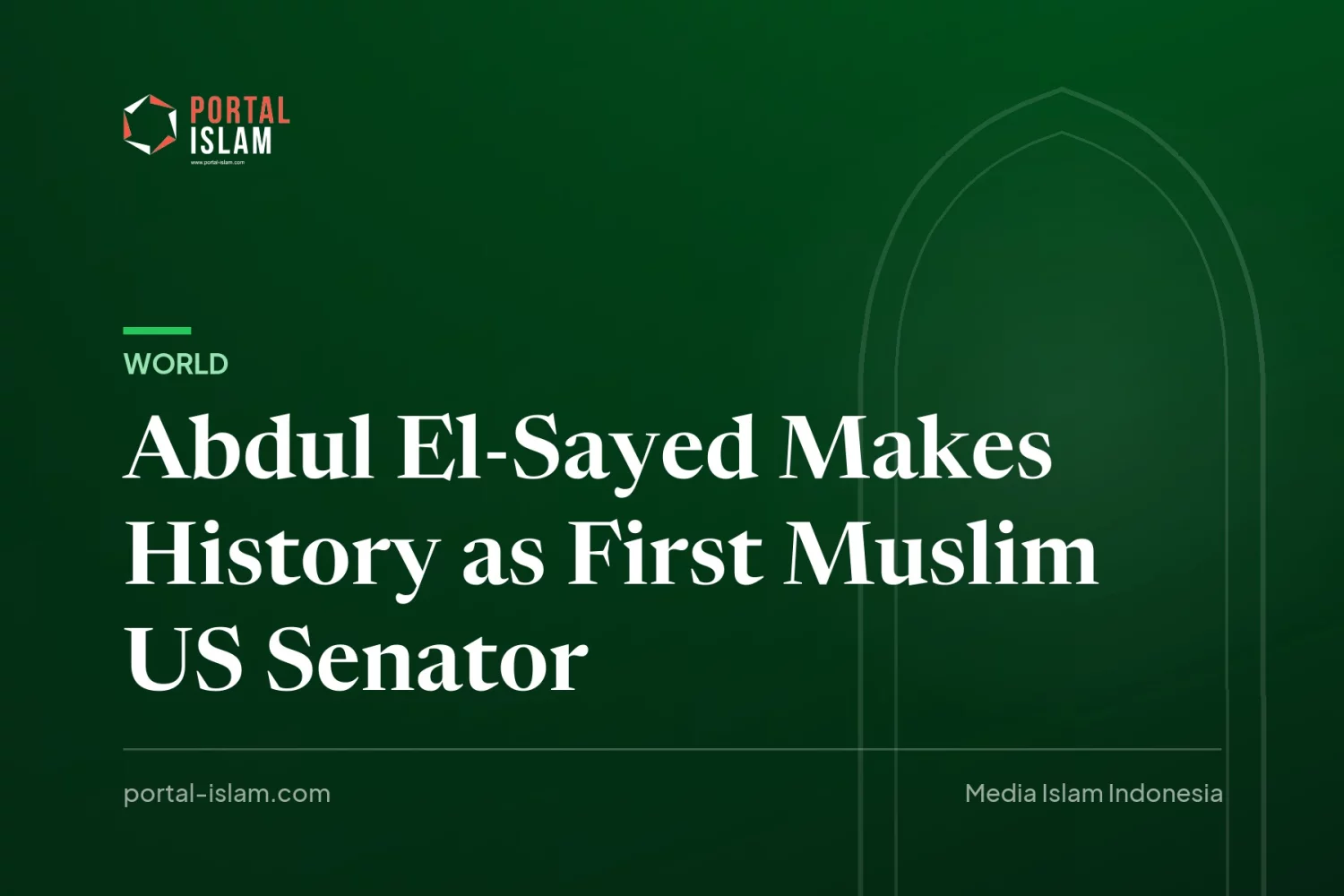
Abdul El-Sayed Makes History as First Muslim US Senator
Progressive Democrat Abdul El-Sayed has made history as the first Muslim elected to the US Senate, winning Michigan's Senate seat in the midterm elections.
 Portal Islam



This article was first published in Indonesian. Baca versi Bahasa Indonesia →
DETROIT — Progressive Egyptian-American politician Abdul El-Sayed has made new history in the United States midterm elections held on Tuesday, November 3, 2026. Based on reports from ANTARA and CNN Indonesia, El-Sayed successfully won a US Senate seat from the state of Michigan after defeating Republican candidate Mike Rogers. This achievement makes him the first Muslim citizen ever elected as a US Senator.
According to reports from CNN Indonesia, El-Sayed was projected to secure the Senate seat after winning approximately 52.5 percent of the vote, although official tally results from the authorities are still pending. El-Sayed won this victory to fill the position left vacant by retiring Democratic Senator Gary Peters, as reported by ANTARA.
Background and Career Journey
As cited by ANTARA, 42-year-old Abdul El-Sayed was born in Rochester Hills, Michigan, to Egyptian immigrant parents. Before entering electoral politics, he pursued a career as an epidemiologist and public health official. He completed his undergraduate studies at the University of Michigan in 2007, earned his doctorate in public health from the University of Oxford as a Rhodes Scholar in 2011, and obtained his medical degree from Columbia University in 2014.
His public service career is well-documented from his tenure as the health director for the City of Detroit from 2015 to 2017, where he worked to restore public health services following a financial crisis. El-Sayed ran in the 2018 Michigan gubernatorial primary election, though he was unsuccessful against Gretchen Whitmer. Subsequently, he led the Department of Health, Human Services, and Veterans in Wayne County from 2023 to 2025, before ultimately winning the Democratic primary for the Senate in August 2026 by defeating Haley Stevens.
As a public figure, El-Sayed's career demonstrates that commitment and professionalism can bring benefits to the broader community, aligning with How to Succeed as a Professional Muslim across various fields.
Progressive Support and Campaign Issues
During his campaign, ANTARA reported that El-Sayed received backing from several prominent progressive figures, such as Senator Bernie Sanders, US Representative Alexandria Ocasio-Cortez, and Michigan US Representative Rashida Tlaib. His platform focused on expanding healthcare access through a "Medicare for All" program, lowering housing costs, reducing the influence of wealthy donors in politics, and strengthening economic opportunities for working families.
In foreign policy, El-Sayed has been a vocal critic of US military aid to Israel. He has described Israel's military actions in Gaza as genocide and called for military aid to be subjected to strict conditions or halted entirely. This firm stance became a major point of debate throughout the campaign.
Political Dynamics and Emotional Community Response
El-Sayed's victory came amid various internal party dynamics and political attacks. According to reports from ANTARA and CNN Indonesia, his former Democratic primary rival, Haley Stevens, surprisingly endorsed Republican candidate Mike Rogers just two days before the election. Stevens' move triggered sharp reactions within the Democratic Party. In addition, US President Donald Trump and Republican figures launched harsh criticisms regarding El-Sayed's religious background and political positions, with CNN Indonesia noting that Trump repeatedly accused him of being pro-terrorism. El-Sayed dismissed these allegations, viewing the attacks as an attempt to distract the public from economic issues.
This historic victory was greeted with deep emotion by Muslims in the US. According to a CNN Indonesia report citing CBS News, California campaigner Abdullah Memon expressed his feelings:
At the watch party, I'm not an emotional person, but I got a little teary. Seeing him and his wife wearing the hijab, and his family, they are American Muslims just like me, and that made me proud to be an American,
Abdullah Memon
The participation of Muslim women in the public sphere offers important inspiration regarding the role of Muslim Women in the Modern Era in supporting and contributing to society.
A similar sentiment was shared by Saad Ijaz, a supporter and campaigner from Washington, D.C. He recounted how this victory provided new hope for his family:
I think yesterday was a really touching day watching Abdul give his victory speech. My younger brother, who is 13, gets picked on at school a lot. For the first time, he told me that he felt like there was hope,
Saad Ijaz
For the first time, someone who shares my faith and background is able to represent my community not just in Michigan but across the entire country,
Saad Ijaz
Lessons for the Ummah
Abdul El-Sayed's presence in the US Senate extends the historical record of Muslim representation on the American political stage, following the previous elections of Keith Ellison to Congress in 2006, and Rashida Tlaib and Ilhan Omar in 2018, as noted by ANTARA. This success reflects that perseverance, integrity, and dedication are pathways to providing broader benefits for humanity.