Tafsir Surah Al-Kafirun: Boundaries of Faith and Tolerance
Explore the profound meaning of Surah Al-Kafirun. Discover how this chapter teaches true religious tolerance while firmly upholding Islamic monotheism.
 Portal Islam



This article was first published in Indonesian. Baca versi Bahasa Indonesia →
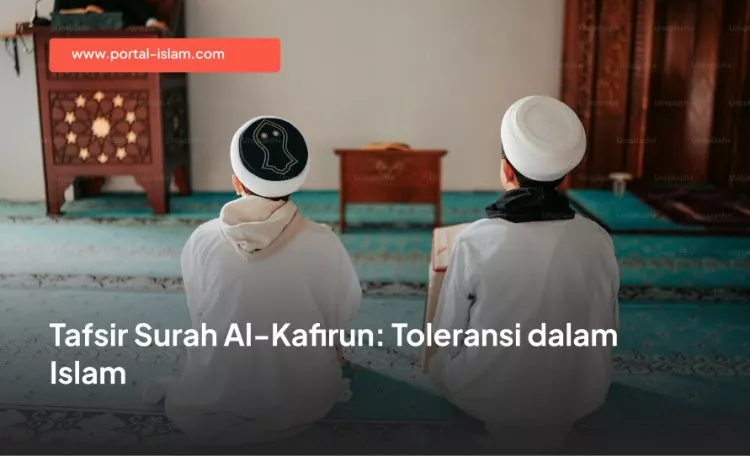
Surah Al-Kafirun is one of the short chapters in the Qur'an that holds profound meaning regarding the principle of tolerance in Islam. This 109th chapter consists of six verses often cited as a primary reference for understanding Islam's stance on religious diversity. In this article, we will examine the tafsir (exegesis) of Surah Al-Kafirun, the meaning of tolerance according to Islamic teachings, and its relevance in daily life.
Text and Translation of Surah Al-Kafirun
Below is the text and translation of Surah Al-Kafirun:
-
قُلْ يَا أَيُّهَا الْكَافِرُونَ
(Say, "O disbelievers,") -
لَا أَعْبُدُ مَا تَعْبُدُونَ
(I do not worship what you worship,) -
وَلَا أَنتُمْ عَابِدُونَ مَا أَعْبُدُ
(Nor are you worshippers of what I worship.) -
وَلَا أَنَا عَابِدٌ مَا عَبَدتُّمْ
(And I will not be a worshipper of what you worship, -
وَلَا أَنتُمْ عَابِدُونَ مَا أَعْبُدُ
(Nor will you be worshippers of what I worship.) -
لَكُمْ دِينُكُمْ وَلِيَ دِينِ
(For you is your religion, and for me is my religion.")
Background of Revelation
According to commentators of the Qur'an, Surah Al-Kafirun was revealed in response to a compromise offer made by the Quraysh leaders to the Prophet Muhammad ﷺ. They proposed taking turns in worship: for one year the Quraysh would worship Allah, and for the next year the Muslims would worship idols. However, the Prophet firmly rejected this offer because it directly contradicted the core principle of tawhid (monotheism).
Tafsir and Meaning of Surah Al-Kafirun
This chapter emphasizes the steadfastness of Muslims in preserving the purity of their faith while maintaining respect for the beliefs of others. Several key points emerge from its tafsir:
-
Rejection of Syncretism
The verses reject syncretism, or the blending of religious practices between Islam and other beliefs. Islam possesses a solid foundation of tawhid: worshiping Allah alone. -
Religious Tolerance
The concluding sentence, "For you is your religion, and for me is my religion," serves as a foundational basis for tolerance in Islam. This demonstrates that despite differences in belief, Islam teaches respect for freedom of religion. -
Firmness in Principle, Not Violence
The chapter also teaches that differences in belief do not warrant violence or coercion. Allah states in Surah Al-Baqarah, verse 256:
لَا إِكْرَاهَ فِي الدِّينِ
("There is no compulsion in religion.")
Authentic Hadith on Islamic Tolerance
Tolerance in Islam is further underscored in various traditions of the Prophet. One relevant hadith states:
مَنْ قَتَلَ مُعَاهَدًا لَمْ يَرَحْ رَائِحَةَ الْجَنَّةِ
(Whoever kills a mu'ahid [a non-Muslim living under a peace treaty or protection in a Muslim state] will not smell the fragrance of Paradise.)
Narrated by al-Bukhari, no. 3166
This hadith affirms that Islam respects the right to life and security of non-Muslims living peaceably alongside Muslims.
Views of Islamic Scholars
-
Ibn Kathir
In his exegesis, Ibn Kathir emphasized that Surah Al-Kafirun is a decisive declaration of the boundary between Islamic creed and other beliefs. Yet, it is not a call to hostility, but an acknowledgment of the reality of human diversity. -
Buya Hamka
In Tafsir Al-Azhar, the prominent Indonesian scholar Buya Hamka explained that Surah Al-Kafirun manifests the peaceful nature of Islamic teachings. For him, the verses teach Muslims to remain firm in religious principles while honoring freedom of conscience.
Relevance in Modern Life
-
Harmonious Coexistence
In the era of globalization, Muslims frequently live alongside adherents of other faiths. The principle of "Lakum dinukum waliyadin" acts as a guide to harmonious living in diverse societies. -
Respecting Religious Rights
Islam recognizes every individual's right to choose their beliefs without coercion, aligning with universal humanitarian principles that protect religious freedom as a fundamental right. -
Countering Radicalism
Understanding Surah Al-Kafirun helps Muslims counter radical ideologies that dismiss the principles of tolerance. Islam is a religion of peace that upholds deep respect for differences.
Data on Tolerance in Muslim-Majority Societies
According to studies by the Pew Research Center, Muslim-majority countries often exhibit high levels of tolerance toward religious diversity, particularly in regions like Southeast Asia. This reflects the practical implementation of Islamic teachings in social life.
Conclusion
Surah Al-Kafirun remains a vital chapter filled with crucial lessons on tolerance and respect for differing beliefs. Through deep comprehension and tafsir, Muslims can apply these principles daily, ensuring that the nature of Islam as a mercy to all worlds (rahmatan lil 'alamin) is genuinely felt by all humanity.
In conclusion, let us use Surah Al-Kafirun as a reminder to always respect differences, guard our faith, and live harmoniously in a diverse society.