Gaza Under Fire: 25 Killed as Famine Grips the City
At least 25 Palestinians were killed in Israeli strikes as famine is officially declared in Gaza, intensifying global calls for an immediate ceasefire.
 Portal Islam



This article was first published in Indonesian. Baca versi Bahasa Indonesia →
Palestinians sheltering in makeshift tents or searching for scarce food aid are among at least 25 people killed by Israeli strikes and shelling on Saturday in Gaza, according to local hospitals. This comes as the world faces the stark announcement that famine is now gripping Gaza City.
The determination of famine by leading global authorities on food crises has prompted governments and aid groups to intensify pleas for Israel to halt its 22-month offensive in Gaza. Aid organizations have warned for months that the war and Israeli restrictions on food entering Gaza are causing starvation among the civilian population.
Israel has denounced the famine declaration as a lie, and its military continues preparations to seize Gaza City. Ceasefire efforts that could potentially prevent the assault remain on hold while mediators await Israel's next move.
Hospitals in Gaza receive new casualties
Israeli strikes killed at least 14 people in the southern Gaza Strip early Saturday, according to morgue records and health workers at Nasser Hospital. Officials stated that the strikes targeted refugee shelters in Khan Younis, which has become home to hundreds of thousands of people displaced from various parts of Gaza. More than half of the casualties were women and children.
Awad Abu Agala, an uncle of two children who died, said there is no safe place in Gaza at the moment.
"The entire Gaza Strip is being bombed... In the south, in the north, everywhere," Abu Agala told The Associated Press, adding that the children were targeted overnight while in their tents.
A grieving relative, Hekmat Foujo, pleaded for a ceasefire.
"We want a break," Foujo said, holding back tears. "Have mercy on us."
In northern Gaza, Israeli fire killed at least five people searching for aid on Saturday near the Zikim crossing with Israel, where United Nations convoys and other agencies enter the enclave, health officials at the Sheikh Radwan field hospital told the AP.
Six others were killed in separate strikes across Gaza on Saturday, according to hospitals and the Palestine Red Crescent Society.
The Israeli military did not immediately respond to inquiries regarding these deaths.
Famine announcement increases pressure
A report by the Integrated Food Security Phase Classification (IPC) stated on Friday that Gaza City is suffering from famine, which is likely to spread if fighting and restrictions on humanitarian aid continue.
It was a rare declaration from the group—the first in the Middle East—and follows a 2 1/2-month blockade imposed by Israel earlier this year, which was later eased with a focus on new private aid suppliers supported by the US, the Gaza Humanitarian Foundation (GHF).
Responding to global outrage over images of emaciated children, Israel has in recent weeks allowed aid deliveries via air and new aid convoys entering by land, but the UN and other aid agencies state that the food reaching Gaza remains insufficient.
AP journalists have witnessed chaos and security issues on roads leading to aid deliveries, and there have been reports of Israeli forces firing at those seeking aid. The Israeli military stated they would fire warning shots if anyone approached troops or posed a threat to soldiers.
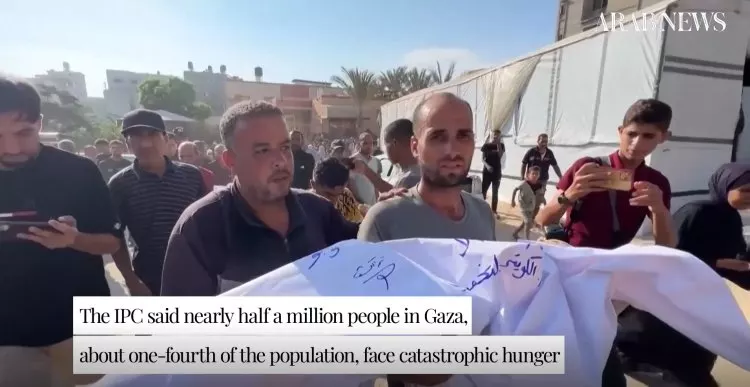
The IPC stated that nearly half a million people in Gaza, about a quarter of the population, are facing catastrophic hunger, leaving many at risk of death. It noted that the famine has been exacerbated by widespread displacement and the collapse of food production.
Prime Minister Benjamin Netanyahu's office denounced the IPC report as a "big lie" and accused Hamas of starving the hostages. Israel maintains it has allowed sufficient aid into the territory during the war.
Activity increases ahead of Gaza City assault
With ground troops already active in strategic areas, large-scale operations in Gaza City could begin within days.
The aid group Doctors Without Borders (MSF) said on Saturday that its clinics around Gaza City were receiving large numbers of patients as people fled recent bombardments. In a statement, the group said that "attacks are again forcing people, including MSF staff, to leave their homes, and we are seeing displacement throughout Gaza City."
The Israeli military said its forces are operating on the outskirts of Gaza City and in the city's Zeitoun neighborhood.
Israel asserts that Gaza City remains a Hamas stronghold, containing a network of militant tunnels. The city is also home to hundreds of thousands of civilians, some of whom had fled from elsewhere.
Ceasefire efforts await Israeli response
Many Israelis are concerned that an assault on Gaza City could result in the death of the approximately 20 hostages who have survived in captivity since 2023.
Netanyahu said on Thursday that he had instructed officials to immediately begin negotiations to release the hostages and end the war according to Israel's terms. It remains unclear whether Israel will return to the protracted negotiations mediated by the United States, Egypt, and Qatar after Hamas said earlier this week that it had accepted a new proposal from Arab mediators.
Hamas has stated it would release captives in exchange for an end to the war, but rejects disarmament without the establishment of a Palestinian state.
US President Donald Trump expressed his frustration with Hamas's stance, stating the militant group has little interest in making a deal to release the hostages because few remain alive.
"This situation must end. It is extortion, and it must end," Trump told reporters on Friday. "I actually think (the hostages) are safer in many ways if you go in quickly and really get it done."