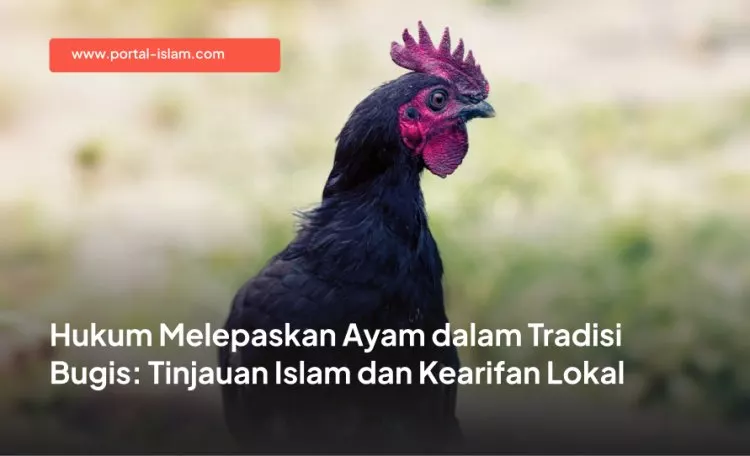
Releasing Chickens in Bugis Tradition: An Islamic Review
Explore the Islamic view on the Bugis tradition of releasing chickens. Learn when local customs align with Islamic monotheism and when they cross the line.
 Portal Islam



This article was first published in Indonesian. Baca versi Bahasa Indonesia →
In Bugis culture, releasing chickens during traditional ceremonies or specific activities is a custom with symbolic meaning. Some people release chickens in rice fields, graveyards, or even with the intention of warding off jinn. However, what is the Islamic perspective on this practice? Does this action have a basis compliant with Islamic law, or does it contradict religious teachings?
This article examines the legal ruling on releasing chickens according to Islam, supported by evidence from the Qur'an, hadith, and scholarly opinions. We will also discuss several examples of releasing chickens within Bugis tradition and how this practice should be viewed from a religious perspective.
1. The Ruling on Releasing Chickens with Specific Intentions in Islam
In Islam, every action we perform must be grounded in a good intention and must not contradict the principles of monotheism (tawhid). Releasing chickens as part of a local custom might simply be regarded as a cultural form, but the primary question concerns the underlying purpose of the action.
If releasing chickens is done with specific beliefs containing elements of shirk (associating partners with Allah), such as warding off misfortune or driving away evil spirits, then the act is clearly impermissible in Islam. Allah states:
"Say: 'Indeed, my prayer, my rites of sacrifice, my living and my dying are for Allah, Lord of the worlds.'"
(Surah Al-An'am: 162)
This verse affirms that all forms of worship and devotion must be directed solely to Allah. If releasing chickens is done with expectations placed on other than Allah—such as spirits or other unseen entities—then it falls into the category of major shirk, which is strictly prohibited.
The Prophet Muhammad ﷺ said:
"Whoever hangs an amulet has committed shirk."
Narrated by Ahmad
Shirk is a grave sin in Islam, and all forms of belief or rituals seeking protection from anything other than Allah fall into this category.
2. Examples of Releasing Chickens in Rice Fields or Graveyards
In some Bugis traditions, chickens are released in rice fields with the hope that crops will thrive and remain pest-free. Others release chickens in graveyard areas intended as offerings or as a sign of respect to ancestral spirits. It is important to note that Islam deeply respects local customs and cultures as long as they do not violate Islamic law.
However, if the tradition of releasing chickens is accompanied by the belief that it brings blessings or prevents disasters without involving Allah, it must be critically examined. Allah firmly prohibits humans from performing baseless rituals that lack religious guidance.
Allah states in the Qur'an:
"Or have they partners [with Allah] who have ordained for them a religion which Allah has not permitted?"
(Surah As-Shura: 21)
Islam teaches that blessings come from Allah, not from any creature or object. Therefore, traditions like releasing chickens in graveyards for specific purposes without an Islamic legal basis can be considered innovation (bid'ah), which is discouraged.
The Prophet said:
"Whoever introduces something into this matter of ours that is not part of it will have it rejected."
Agreed upon (Bukhari and Muslim)
3. Releasing Chickens to Repel Jinn or Unseen Disturbances
In some places, a belief persists that releasing chickens can drive away jinn or prevent disturbances from unseen creatures. Such actions, if based on the belief that chickens possess the power to protect humans from jinn or supernatural beings, can also be categorized as shirk. In Islam, the only protector against unseen disturbances is Allah.
Allah states:
"And if an evil suggestion from Satan comes to you, then seek refuge in Allah. Indeed, He is the Hearing, the Knowing."
(Surah Al-A'raf: 200)
The Prophet also taught us supplications for protection against jinn disturbances:
"I seek refuge in Allah from the accursed Satan."
(Surah Al-Mu'minun: 97)
Practicing dhikr, du'a, and reciting portions of the Qur'an such as Ayat al-Kursi (Surah Al-Baqarah: 255), Surah Al-Falaq, and Surah An-Nas are the lawful ways to protect oneself from unseen harm. There is no basis in Islam justifying the release of chickens as a means to repel jinn or devils.
Conclusion and Daily Life Implications
Islam acknowledges local wisdom and indigenous culture, provided they do not conflict with the principles of tawhid and Islamic law. The tradition of releasing chickens in Bugis culture, if performed purely as a cultural form without deviant beliefs, can be regarded as part of heritage. However, if elements of shirk or the belief in special powers residing within the chicken are present, the practice must be avoided.
As Muslims, we must remain cautious when following traditions. Everything we do must align with Islamic teachings and must not stray from the principles of monotheism. Therefore, it is better to increase our supplications and worship to Allah to bring about goodness and avoid all forms of hardship.
The Prophet said:
"That which is lawful is clear and that which is unlawful is clear, and between the two of them are doubtful matters about which many people do not know. So he who guards against doubtful matters has cleared his religion and his honor."
Agreed upon (Bukhari and Muslim)
Thus, let us always purify our intentions in worship, follow the sunnah of the Prophet, and continually make Allah our sole source of reliance.
Sources
This article is adapted from traditional Islamic jurisprudence discussions regarding local customs (urf) and the preservation of pure monotheism (tawhid) in Bugis cultural practices.